

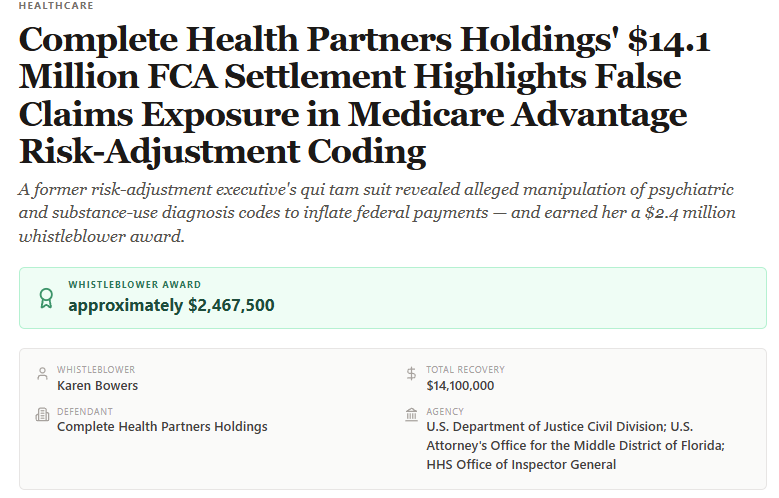
Complete Health Partners Holdings, a Jacksonville-based management services organization overseeing affiliated provider groups in Florida, Alabama, and Colorado, has agreed to pay $14,100,000 to resolve False Claims Act allegations involving Medicare Advantage risk-adjustment payments. According to the government, the company caused clinically unsupported diagnosis codes to be submitted in two specific Hierarchical Condition Categories: HCC 55, covering drug and alcohol dependence, and HCC 59, covering major depressive, bipolar, and paranoid disorders, between 2020 and 2023.
Medicare Advantage plans receive higher capitated payments from the federal government for beneficiaries with more serious diagnoses, thus, submitting codes that do not reflect a patient’s actual clinical condition inflates those payments without a corresponding medical basis. The settlement resolves the allegations without any admission of liability by Complete Health Partners Holdings.
The case originated as a qui tam lawsuit filed by Karen Bowers, a former associate director of risk adjustment at VIVA Health, under the caption United States ex rel. Karen Bowers v. Complete Health Partners, Inc., et al., Civil Action No. 3:22-cv-463, in the Middle District of Florida. Bowers’s professional background in risk adjustment placed her in a position to recognize that the diagnosis codes at issue lacked valid clinical support. For her role in initiating the case and contributing to the federal recovery, she received approximately $2,467,500, roughly 17.5 percent of the total settlement amount, as her relator’s share.
The resolution was secured through a coordinated effort by the U.S. Department of Justice Civil Division, the U.S. Attorney’s Office for the Middle District of Florida, and the HHS Office of Inspector General. The case illustrates how the qui tam mechanism enables insiders with direct knowledge of coding and reimbursement practices to surface potential fraud that might otherwise go undetected through external audits alone. Medicare Advantage risk-adjustment fraud has become a sustained enforcement priority for federal agencies, and cases brought by relators with specialized clinical or administrative expertise, like Bowers, have consistently produced some of the most significant recoveries in this area.