

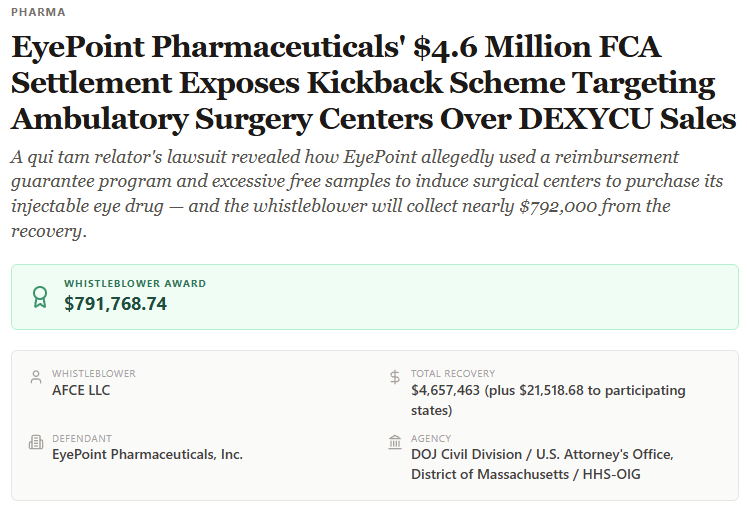
EyePoint Pharmaceuticals, Inc., a Watertown, Massachusetts-based specialty drug company, has agreed to pay $4,657,463 to the federal government — plus an additional $21,518.68 to participating states — to resolve False Claims Act allegations tied to its marketing of DEXYCU, a corticosteroid injected into the eye following cataract surgery to reduce post-operative inflammation.
According to the government’s allegations, EyePoint paid unlawful kickbacks to ambulatory surgery centers through two mechanisms: an “Assurance Program” that reimbursed centers for any gap between what Medicare or Medicaid paid them for the drug and what it actually cost them, effectively eliminating the financial risk of stocking DEXYCU, and the provision of free samples in quantities the government contends were excessive and designed to drive purchasing decisions rather than serve legitimate educational or sampling purposes. The case was investigated and resolved by the DOJ Civil Division, the U.S. Attorney’s Office for the District of Massachusetts, and HHS-OIG.
The lawsuit was filed under the qui tam provisions of the False Claims Act by AFCE LLC, a private entity acting as a relator on behalf of the United States. Qui tam provisions allow private parties with inside knowledge of fraud against the government to file suit in the government’s name and, if the case results in a recovery, to receive a share of the proceeds. That mechanism is what brought these allegations to the government’s attention, and it is what entitled AFCE LLC to a relator’s share of $791,768.74 — roughly 17 percent of the federal recovery. The underlying theory of liability is straightforward: when a pharmaceutical company neutralizes the cost risk that would otherwise lead a healthcare provider to make purchasing decisions on the merits, and when it layers on free product to further cement that relationship, the resulting drug purchases are not the product of independent clinical judgment but of financial inducement — which corrupts the integrity of federal healthcare programs and generates false claims for reimbursement.
In addition to the monetary settlement, EyePoint entered into a five-year Corporate Integrity Agreement with HHS-OIG, a compliance arrangement that imposes ongoing monitoring obligations and provides the government with a mechanism to detect future misconduct. The resolution illustrates how the FCA’s qui tam framework can surface conduct that federal investigators would be unlikely to uncover on their own — in this case, a reimbursement guarantee structured to look like a customer service program and a sample distribution policy that allegedly crossed the line from permissible promotion to unlawful inducement. The anti-kickback statute exists precisely to protect the judgment of clinicians and institutions from being shaped by financial arrangements with manufacturers, and recoveries like this one redirect improperly obtained funds back to the Medicare and Medicaid programs that were allegedly overbilled.